Rick and Morty's Vegan Propaganda
Whoops, it's been two and a half years since I've watched a Rick and Morty episode! Back then, I had watched up through season 6. Then there was the wait for the next season, and I just never got back into it. But now apparently I'm in the mood for it again (and I'm over the fact that they changed the voice actor(s?) starting in S7 -- not that I disagree with their decision to do so, but it had me a little worried that the show would feel different).
FAQ:[1]
- Given this note's title, do I anticipate more examples of vegan propaganda in Rick & Morty? No, not necessarily, though I wouldn't be surprised. It's enough for me to start with the instance in S7 E4.
- "Vegan propaganda" ?? -- take this phrase lightly. It's obviously not actual propaganda. It's just how I'm describing media that has themes around exploitation, especially when it comes to food, and especially when it has a message that is sympathetic to those being exploited. And generally, yes, the exploited one would be an animal (though veganism at its core is against all exploitation, including of humans).
If you aren't familiar with Rick and Morty, and don't mind getting spoiled, feel free to read this. (But honestly, just watch the episode first!) It helps to have a sense of what kind of show Rick and Morty is (hint: weird, chaotic, cartoonishly gory, and often thought-provoking (and funny!)).
Warning: Spoilers for Rick and Morty Season 7 Episode 4
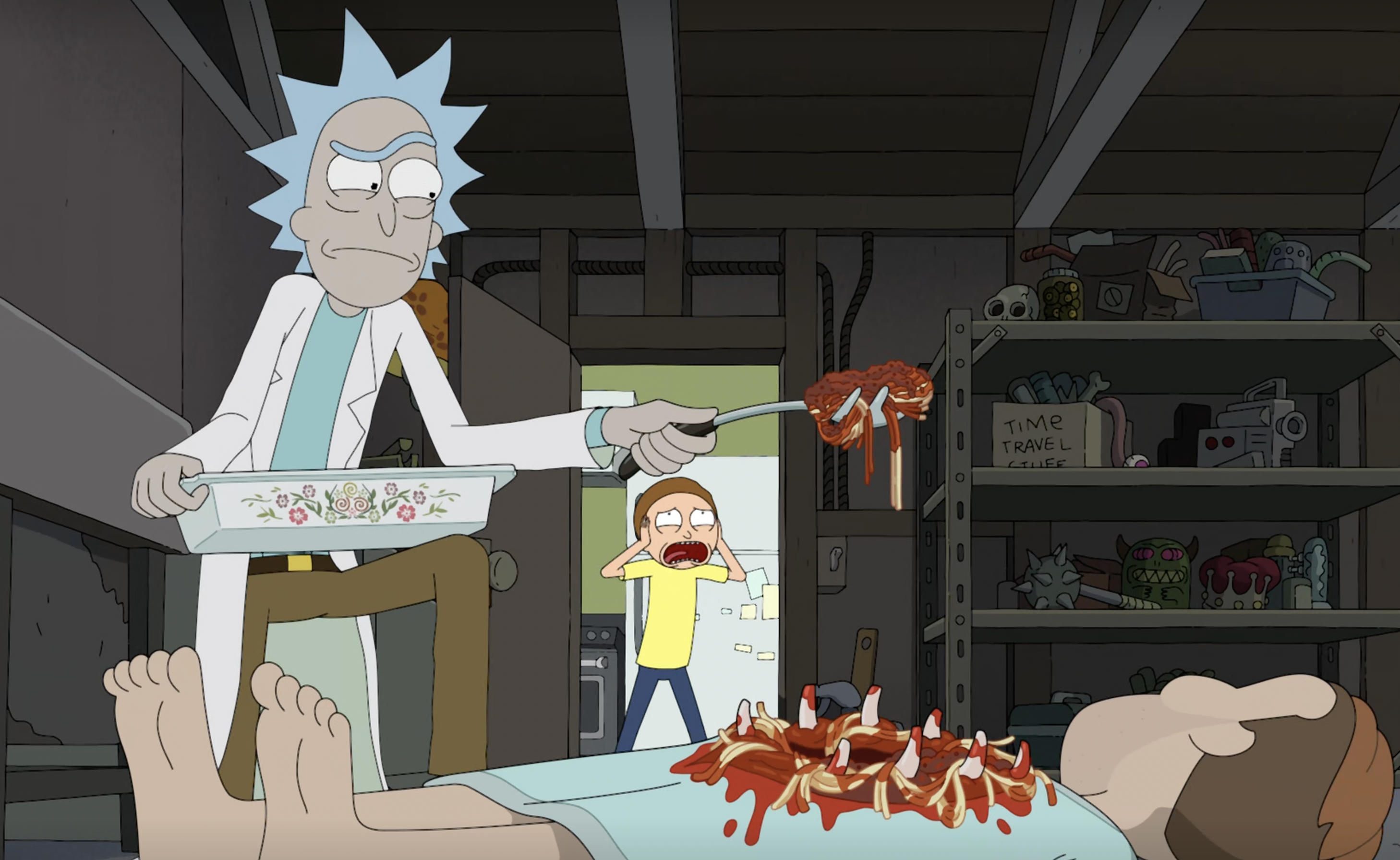
But he was delicious. I hope that helps make it right.
The episode gets straight to the point.
It opens with the family eating Rick's delicious spaghetti with bolognese sauce. The family is raving about its deliciousness (and practically foaming at the mouth, with "sauce").
Pretty quickly, Morty finds out the secret to the deliciousness -- Rick has taken the "food" from the corpse of an alien (which closely resembles a human). Apparently, the people on the alien's planet turn into delicious spaghetti when they die, but only if they die of suicide (it's something specific to the biology of the people on that planet).
With that reveal, I started to sense that the vegan-adjacent themes. It's not about cannibalism (even though the alien looks like a human) because they are definitely not humans (humans don't turn into delicious spaghetti upon suicide; that's enough to differentiate the species[3]). The parallel to veganism so far is: You have a sudden realization about the food that you've been loving - it comes from a dark, morally-questionable place.
Morty feels bad about it. He insists that Rick tell him the name of the people they've been eating as spaghetti. They end up at the funeral of the spaghetti-man, and Morty speaks to the mourners:
Hi. I just want to be honest about something. After Lawrence died, we… …ate him. Wait, we’re not… werewolves or anything, we come from a planet, where to us, when you guys kill yourselves, you turn into what my planet considers food. Spaghetti. It brought us together. Lawrence. Brought us together. It just felt wrong not having anyone know that. But he was delicious. I hope that helps make it right.[4]
Morty genuinely feels bad about the whole situation. At the same time, he is unapologetic about enjoying the taste of the food.
I couldn't help but laugh at those last two sentence -- I was 100% sure that there were vegan undertones at this point. One of the most common reasons that people cite for not wanting (or not "being able") to go vegan, even when talked through a discussion of the moral wrongness of supporting an industry of unnecessary[5] animal suffering, is that meat (and other animal products) simply tastes too good for them to give it up. Any vegan will say that just because the animal "was delicious", it does not "make it right" to have killed them.
Ah, but here is the nuance of the Rick and Morty presentation of this topic -- as I write this, I realize that the nuance actually makes this less vegan propoganda than I might originally have framed it as. At the same time, the point I'm about to make does not negate the vegan theme, but rather approaches it from a slightly different angle than I was originally thinking.
These aliens don't have spaghetti inside them just by dying any death -- it has to be suicide. So they can't be farmed (raised and killed for their insides) in the same way that Earthly animals are. We've hit the topic of consent here. While the aliens are not necessarily given consent to be eaten (though this does come up later in the episode), they have chosen to die.
This changes everything.
(fornow)
Interlude: An Anecdote on Animal Suicide and Roadkill Meat
I didn't realize until getting to this point that I have a recent and relevant anecdote. But it's perfect.
A couple days ago, I was chatting with someone at a friend's birthday party. When it came up that I am vegan, he asked me if I would eat meat if the animal killed itself. I gave him a puzzled look and asked what animal would ever do that. He said something about pigs. My brief response pretty much was:
- it's ridiculous because animals have the biological instinct to survive (and, though it's apparently a bit controversial, there isn't evidence that any animals purposefully kill themselves), and
- even if the animal did intentionally kill itself, it has no way to communicate that intention to us humans, so we couldn't distinguish an intentional death from an unintentional one -- so this (unknowable) distinction would not be relevant to a decision on whether to eat a dead animal or not.
However -- it does bring up another relevant question. Would I (or vegans in general) eat an animal if it died accidentally? An actual example would be roadkill -- e.g. a deer hit by a car.
Some vegans will just say: no, it's an animal, and vegans don't eat animals, regardless of how it died. End of story.
Sometimes I don't mind that simple response, but also, I approach veganism from a rational and logical frame of thinking. So there needs to be more nuanced discussion on edge cases like this.
Eating roadkill is truthfully very different from eating a farmed animal -- and when it comes down to it, it may actually be an ethical action. Let's walk through the difference.
For traditionally farmed animal to get onto your plate, you (in most cases) paid someone for the meat. That exchange of money incentivizes the farmer (and the animal agriculture industry in general) to continue raising and slaughtering future animals. It's a matter of supply and demand. If people demand a product (which you do by purchasing it), the people who want your money will continue to provide it. And in a more direct sense, when you take from the supply of meat, more meat must be produced to keep up the supply for other people[6]. In the world of animal agriculture, this unfortunately means the continuation of the exploitation of animals and the cause of unnecessary suffering and early death for those animals.
But the roadkill, on the other hand, is completely isolated from the economics of the animal agriculture industry. If you choose to consume the meat of that deer, any moral dilemmas are (mostly) contained within the bubble of you and the deer. You aren't sending a signal out to anyone that you want them to keep killing more animals.
In this way, it would indeed be better if you only ever ate road-killed meat. You wouldn't be paying for any kind of animal exploitation. (And presumably you wouldn't be influencing drivers to purposefully hit more deer so you could eat them. If so, then that would be an exploitation situation. You would be causing pain to the animal and taking its life, for your own benefit, when you do not need to.)
And yet, even if road-kill is ethical compared to farmed animal, I personally would still never eat meat in this situation. Why?
I honestly have not thought super deeply about this topic before. But my instinct is that it still just... feels wrong. After being vegan for five years, I feel no desire to consume the flesh of an animal. I seem to have developed this gut-feeling aversion to viewing the carcass of a once-living creature as being food at all. I would feel the same way if the hypothetical were about an accidentally-killed cow or pig or etc. rather than a deer.
Plus, a big reason for staying vegan for me is the health benefits of eating a whole-food plant-based diet. So all ethical points aside, I still wouldn't want to incorporate this hypothetical roadkill situation into my diet. But again, I feel no desire.
But I guess I have to acknowledge that if someone approached me and asked if it's okay for them to eat roadkill, the answer would have to be yes. They genuinely are not hurting anyone by doing it. (My own caveat here would be that by consuming an animal product, they are still promoting the idea of eating animal products to other people in society, which can contribute to the continuation of traditional animal exploitation.)
Back to the spaghetti people
As I was saying, at the start of the Rick and Morty episode, the aliens who commit suicide chose to die.
So it it ethical to eat them?
Well, similar to the roadkill situation, you are doing no harm by eating them. They are already dead.
And yet, something still feels wrong. The person did not give consent to be eaten upon their death. This would be similar, in our world, to someone's body being used for research after they died (though, this seems like its own nuanced subject that I won't dive deeper into here).
We do see engagement with this thought in the episode. Morty is invited back to the planet and is shown a video of another citizen, who was terminally ill, stating that they desire to be eaten after they perform self-euthanasia. This is explicit consent, so I'd say this is the most ethical way to eat a spaghetti-person[7].
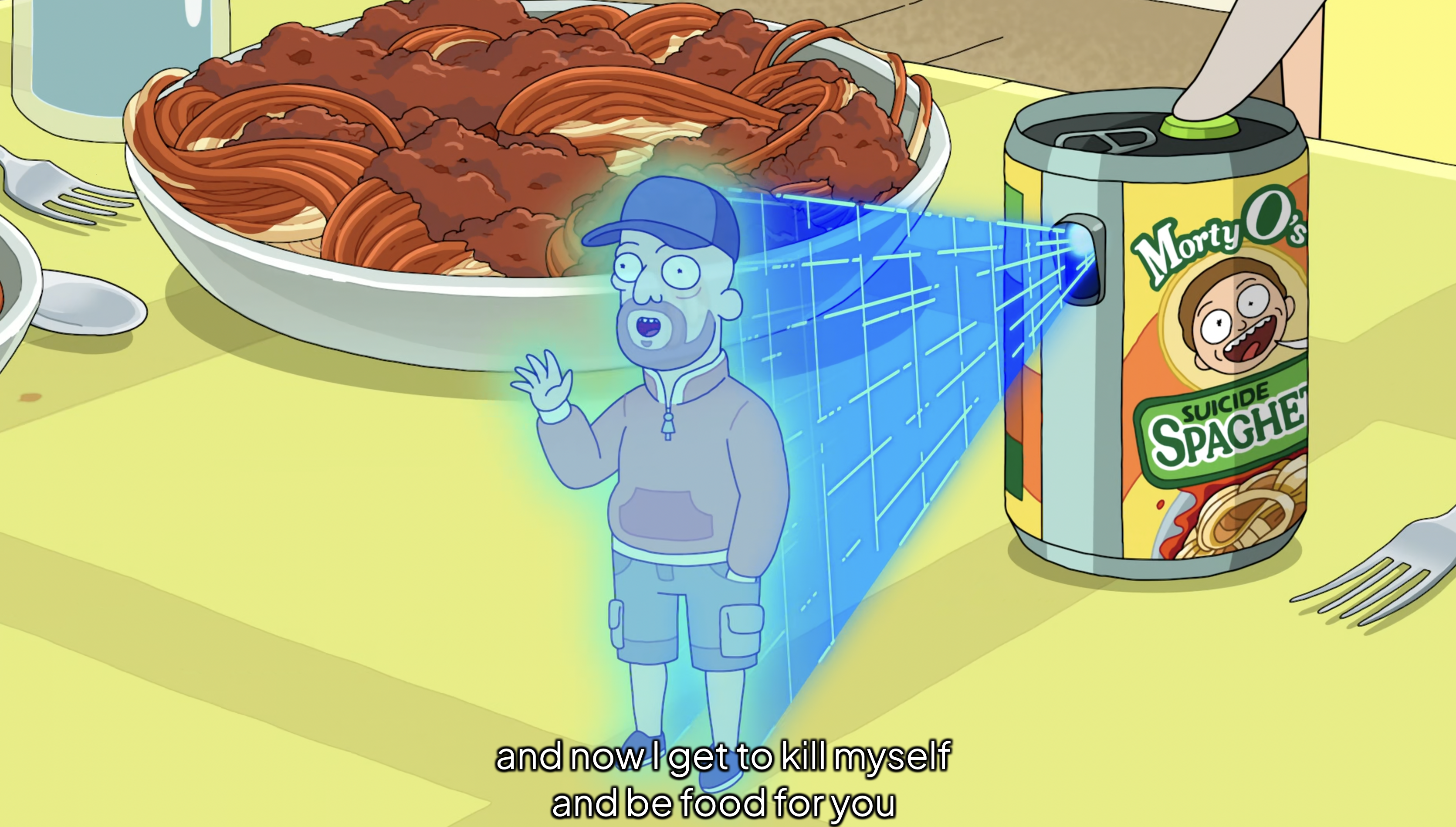
But then, as often happens in this show, things take a turn for the worse.
The government of the planet realizes that they can profit off of the spaghetti-turning biology. Since spaghetti is only manifested after suicide, they start to make the conditions of the planet incredibly depressing. They blot out the sun so it is gray and faded. They televise only bad reality tv. Their billboards promote self-sacrifice (to be someone's food) as something valiant.
The planet has turned into a factory farm, and in the government's (dollar-sign) eyes, the planet is thriving.
Pop quiz. Is this exploitation?
Answer: Yes.
Dictionary.com says: "Exploitation is the act of selfishly taking advantage of someone or a group of people in order to profit from them or otherwise benefit oneself."
The government is exploiting the people for its own profit.
Is it morally acceptable to consume the spaghetti from the exploited people? No! Someone purchasing the spaghetti is adding to the demand and thus will lead to the government continuing to devalue the life of the citizens and essentially coerce them into suicide. This is the strongest parallel to real-world animal agriculture that I'm sensing in this episode (even if there is a nuanced difference with this suicide caveat).
And finally, the end of the episode (and Rick's solution to the problem) brings the topic to a close, with yet another analogue to vegan ideas.
Turning away from the spaghetti industry
Rick decides he needs to put an end to the spaghetti-from-people industry. He locates a spaghetti-man who is close to his natural death, and offers him the chance to stop the spaghetti industry through his euthanasia. Rick plugs the man up to a fancy machine which, right before the man's self-inflicted death, projects the man's lifetime of memories to the people of the planet (and presumably all would-be spaghetti-consumers, who were lining up to buy more people-spaghetti). The projection depicts the most significant and emotional moments of the man's life, including falling in love, getting married, and the passing of his wife.
The man dies. Rick then slices open the man's belly and offers Morty the "delicious" spaghetti. Morty glances at it ... and then immediately vomits. Many who had been watching the video also vomits.
The spaghetti has not changed, but Morty, and all of the prior spaghetti-consumers, have. Suddenly, the idea of eating the spaghetti (or having eaten it previously) has become so revolting that it's vomit-inducing. It's clear that they will never consume the spaghetti again.
What happened?
With the pure, unfiltered video of the dying man's life-moments, the would-be spaghetti-consumers were granted a new perspective. It forced them to internalize the truth that the spaghetti-people are not just soon-to-be-spaghetti vessels to be eaten; they were real people who had a life experience just like the consumers.
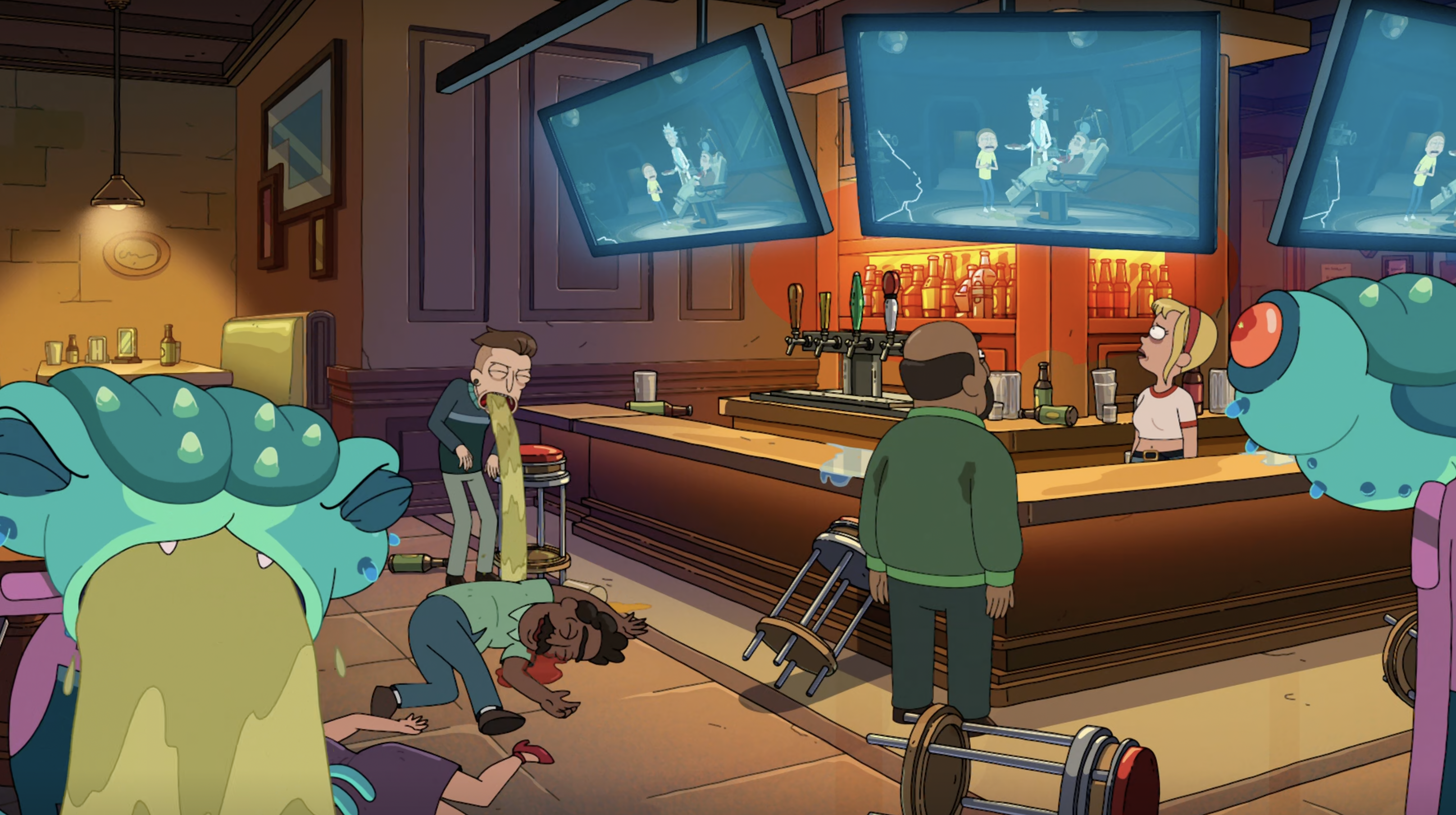
The thing is, there was never secrecy around the way the spaghetti was generated. The consumers knew that the people had to die of suicide in order for them to get their spaghetti. But they didn't care, and consumed from the industry anyway. It took a change of perspective for them to re-think (maybe subconsciously) the feeling of desire for the "food".
Morty: You couldn’t change everyone’s taste, but you could make it… distasteful. It wasn’t the death, was it?
Rick: It was the complexity of life.
Morty hits an important point -- even though the people may still think the spaghetti tastes good[8], something mental has shifted that makes them view it no longer as desirable food. (Similar to my point in the interlude about the gut-instinct undesirability of road-killed deer meat even if it technically it could be considered ethical.)
Re-thinking food in our own world
It's not hard to draw the parallel from the episode to the real world. Becoming vegan is to re-think where our food came from. Most of us are born into a society where consuming animal products is a normal thing which almost everyone around us does, and there is no reason to question it. That is, until something makes us re-think it. For me, it was a video of Ed Winters talking about the philosophy of veganism. For others, they may chance upon a Cube of Truth demonstration and see the gory footage of the animal industry.
Whatever plants the seed in a person's mind, they stop seeing their (animal-based) food as just food. It came from an animal who was previously alive, and who had an experience of life. It may be a very different experience of life than humans have, but we come to understand that animals can have emotions, can be playful, can feel bonds with fellow animals (including humans!), and, above all, we see that they can experience pain and suffering.
None of that should sound surprising. We all know these things. And yet, just like the spaghetti-eaters, we don't think about it, or don't care, or don't see it as something to question. But when we connect the dots between the food on our plate and the animal that it used to be[9], this new perspective can make the food suddenly distasteful. And this can be enough for a person to start changing their choices around food.
Rick as activist
In a strange way[10], Rick was being an activist. He forced people to confront where their food came from, and made a real difference. This isn't too different from what vegan activists aim to do when they have open conversation with non-vegans to try to get them to see a new perspective on the systems of exploitation in our society.
Final thoughts
I enjoyed thinking more deeply about this episode and exploring the parallels which instinctively were obvious to me (but which were not fully formed in my mind until I actually went through the process of writing this). Great example of deeper meaning that can be extracted in media, and the value of contemplating it. This was fun! I'm glad I have this digital garden as a place to motivate me to do things like this. One of the earliest things I read about digital gardens / personal sites / blogs in general was encouraging people to do a talk-back to media you consume. To directly respond to what you've consumed is probably the most direct way to follow the Create More Than You Consume advice.
no, nobody has asked these questions ↩︎
An example of this that baffles me is the movie Chicken Run. The movie is about chickens on a farm that are trying to escape being turned into meat pies. The movie has real emotion and it's driven by making the viewer empathetic toward the chickens' survival. And, with a very small sample size on my end, for some people it does not even cross their mind that this may be related to the topic of veganism. ↩︎
technically.... we need to know if these aliens can have viable offspring with humans to really classify them as a different species. But, please. They aren't human. (Maybe there is another perspective to this, though.) ↩︎
taken conveniently from https://rickandmorty.fandom.com/wiki/That's_Amorte/Transcript ↩︎
"unnecessary" because humans can survive+thrive on a fully plant-based diet ↩︎
Obviously your one hamburger does not literally correspond to another fraction of a cow needing to be killed, but it adds up in the grander scheme. How many less cows would need to die during your lifespan if you personally never ate another hamburger? ↩︎
... in case you were considering doing so. ↩︎
semi-related: Why do I stay vegan enough though I miss certain foods? ↩︎
or, for animal-derived products like milk and eggs, think about the animal that had to suffer to produce it and eventually was still killed earlier than its normal lifespan due to being part of the industry ↩︎
(...if we ignore that he himself continued to eat the spaghetti) ↩︎