The Left Hand of Darkness (Ursula K. Le Guin)
Taking notes during my re-read[1] for book club in May 2026. Currently mostly listening to the audiobook version (my original read was ebook in 2020) but also may switch between ebook as well.
Notes taken during audiobook re-read
-
I'm remembering why I liked this. It's kind of like a case study of anthropology. Person comes to learn about a culture. But also part less like anthropology: also aiming to establish relations/allyship and trade and make them a part of a larger entity/system.
-
The cultural mythology (stories) interspersed so far reminds me of what Le Guin kind of was teaching with Always Coming Home -- you learn a lot about a culture from their stories and mythos.
-
Expanding on my first point, I wonder how much of the message here has to do with the negative aspects of colonialism.
- My instinct is that we are actually being presented with a good way to establish contact with a different culture and develop positive and respectful relations and exchange.
- But the king's speech to Genly brings up what is probably a common point (in real life) against even this kind of interference -- they are fine on their own, they are doing well on their own, what do they need from the outside?
- This reminded me of hearing about certain indigenous tribes who have been completely undisturbed by outsiders -- they do fine for themselves and maybe wouldn't want to be disturbed. Yet, is that really their answer? I don't know. Maybe they want to stay isolated, but maybe they would be open to exchange (of technology, ideas, etc). There's probably no right answer.
- It also kind of reminds me of the environmental dilemma I mentioned that the Mars trilogy explores -- (I just expanded on some of these thoughts here), but of course it's different when talking about a human civilization/group.
-
So far the subject of foretelling has only been briefly mentioned (though we got a whole tale about it). The foretelling from the tale reminded me of the Aelfinn and Eeelfinn from The Wheel of Time. Your prophecy may come true in a strange and ironic way.
-
Distinction of "supper" and "dinner" is kind of funny. If I ever have two separate dinners, I will call the first one supper and the second one dinner.
-
Obviously a lot of discussion of gender and sexuality within this. I appreciated the section that was just direct discussion of these topics with regards to the Gethenian physiology. I'm surprised I didn't reflect on this more during my first read through (I think I was just more focused on the sci-fi adventure / politics / ekumen aspect.)
- The themes on gender also are reminding me of the gender discussions in Terra Ignotta - in that universe, people dressed so as to not reveal what gender they are (so it's different from TLHOD in that they do have different genders of course). The reasoning was I think to remove the negative aspects of gender differentiation - this played a role in the Terra Ignotta plot and politics (won't spoil anything here). It's a strong parallel because it feels like TLHOD is also making a point about what lack of gender does to social/political life (obviously).
-
Shifgrethor concept is reminding me of The Wheel of Time's concept of ji'e'toh[2], though not exactly the same.
-
Estraven's journal snippets is slightly making me want to do my own (private) journaling more often.
-
Got chills when Ai said that Estraven's actions were not for the sake of any one nation but for all of mankind. I feel like this is a thing in scifi that commonly excites me. To act in advancement of humanity. Similar feelings to Foundation (Asimov), and Terra Ignotta, and Book of the New Sun. It really is a common theme.
-
On Difference
- In our real world, someone being nonbinary, transgender, or otherwise of the non-majority gender or sexuality, is viewed as different.
- On the fictional world of Gethen, being androdynous is the norm and Genly Ai is seen as a deviant given his permanent state of male sexuality.
- This evokes lessons of ethnocentrism. Enter a new culture and do not view it as strange from the perspective of your own culture. Instead, view it from its own lens and accept that it is what it is. It is not an affront on your own. And of course, not just on the level of a culture, but on the differences from individual to individual.
- Evokes a sentiment I have felt before along the lines of answering "why is this the way things are?". Things could easily have been different. An example of this is something I sometimes feels around veganism when considering the different views a person may have between vegan and non-vegan food. Mainly in comparing taste and recipes.
- It can seem like vegan food is inferior to non-vegan food. Kind of I am talking about veganized food rather than food that was already vegan (as most cultures have) i.e. making a vegan cheese substitute. For this kind of thing, vegans have been working on these substitutes for decades, or perhaps longer than that. But the dominant culture has been mastering non-vegan cooking for thousands of years, so it is a surprise that non-vegan food is more advanced and suited to our tastes? It is almost exciting to me to be on the frontier of vegan cooking, when put this way. It also leads to the point I'm getting to. Yes, it happens that our human culture's food had its roots in animal-derived ingredients. Yet there could equally have been a human culture that developed without animal-derived ingredients, which mastered non-vegan food over thousands of years, and would look at some new revolution of animal-based cooking as inferior and less good tasting (whether objectively less good tasting, or simply different than one's accustomed tastes).
- From the introduction to Wildman Steve Brill's vegan foraged-food cookbook: "The great world cuisines came into being when people in diverse ecosystems and climates experimented with limited regional food resources and technologies over long periods of time, and shared their knowledge through trading." This isn't the point Brill is making, but I feel this supports my point of the scale of time needed for a cuisine to mature. It also lends to the idea of how creative vegan cooking is / can be, given the constraints.
- My analogy to gender differences in Gethen/Earth should be clear. I ask my fellow human to look at my vegan food from the perspective of its inherent properties rather than as a comparison to your accustomed culture; evaluate it fairly and give it an equal chance as if you stumbled upon a food tradition from another world that maybe you could come to enjoy.
- It can seem like vegan food is inferior to non-vegan food. Kind of I am talking about veganized food rather than food that was already vegan (as most cultures have) i.e. making a vegan cheese substitute. For this kind of thing, vegans have been working on these substitutes for decades, or perhaps longer than that. But the dominant culture has been mastering non-vegan cooking for thousands of years, so it is a surprise that non-vegan food is more advanced and suited to our tastes? It is almost exciting to me to be on the frontier of vegan cooking, when put this way. It also leads to the point I'm getting to. Yes, it happens that our human culture's food had its roots in animal-derived ingredients. Yet there could equally have been a human culture that developed without animal-derived ingredients, which mastered non-vegan food over thousands of years, and would look at some new revolution of animal-based cooking as inferior and less good tasting (whether objectively less good tasting, or simply different than one's accustomed tastes).
-
At the end, Ai acknowledges that he has gotten used to the cold of the world after being there for 2+ years. This evokes that when you immerse yourself in another culture, another worldview, another spirit, you can not just observe; you will be changed by it. You do not leave the same. Reminds of me Avatar (blue people).
-
Very ending - Ai visits Estraven's family in their home domain. He at first wonders if it was useless for him to visit, because seeing Estraven's father only seems to confirm his death. However, there is a certain respect and admiration and interest that the father and Estraven's son display to Ai. This left me with a feeling that perhaps Ai had found a bit of a family here, serving as an uncle figure (to the younger one at least). Maybe this is just the audiobook narration (excitement in the character voices) getting to me. But I like to think that Ai's closeness to Estraven might be clear to the family and so they may extend a familial feeling to Ai.
-
Ekumen. In both my first and second read/listen, I am very drawn to the idea of the Ekumen, the union of many worlds. Still makes me want to read more of Le Guin's take on it. I recall after reading it the first time, I was disappointed that it didn't seem there was more of a direct take on the Ekumen. But I still haven't read all her books, so how can I be sure. I definitely want to read more. At the top of my list to get to are The Dispossessed and The Lathe of Heaven (and especially this one since it relates to dreams). I'm guessing that Rocannon's World would probably fulfil my craving the most - synopsis sounds similar to LHOD, about ethnologist visiting a planet.
-
I haven't watched much of Doctor Who except for a couple episodes, but it also makes me feel like I should watch more Doctor Who. Might not be super related though. But I think there's something there. Obviously it's space travel scifi. But calling out more is the idea of visiting new strange places and understanding the people there.
-
My friend who read LHOD also had mentioned he read Le Guin's commentary on the book's themes, so I'm seeking that out.
- ChatGPT tells me her essay "Is Gender Necessary? Redux" is what I'm looking for: https://theanarchistlibrary.org/library/ursula-k-le-guin-is-gender-necessary-redux. (btw theanarchistlibrary looks interesting. they've got a little community there. apparently it's an archive for anarchist writings. Not exactly sure if/how Le Guin fits in here but I'm glad they are hosting this essay so I can read it at this very moment. (okay well maybe asking whether gender is necessary is an anarchist topic... I suppose it depends on your definition of anarchy))
- Wow, very interesting from the start, Le Guin acknowledges that her opinion changed over the years, which is why this is a "Redux" of her original essay. It's the original essay but with revised commentary in brackets.
- "The fact is that the real subject of the book is not feminism or sex or gender or anything of the sort; as far as I can see, it is a book about betrayal and fidelity."
- i kind of love that she acknowledges that the more important theme of the book is not the sensational-seeming one. This resonates me, especially given I didn't reflect too much on the gender stuff my first time through (it was really always the adventure and journey and ethnology and ekumen-ness that stuck with me).
- Oh wait... I'm fooled. This is one of the statements she corrected. "“The fact is that the real subject of the book is …” This is bluster. I had opened a can of worms and was trying hard to shut it. “The fact is,” however, that there are other aspects to the book, which are involved with its sex/gender aspects quite inextricably."
- "One of the essential functions of science fiction, I think, is precisely this kind of question-asking: reversals of a habitual way of thinking, metaphors for what our language has no words for as yet, experiments in imagination."
- I feel I don't think about scifi through this lens enough. I think it likely is why I love it so much. The thought experiment aspect of it, the aspect of making commentary on society via metaphor. At the surface level, though, I feel I'm often drawn by the exciting adventure/technology topics.
- "The basic social unit all over the planet is a group of two hundred to eight hundred people, called a hearth"
- cites this as a reason for lack of wars in Gethen. Reminds me of the social structure in Terra Ignotta's world (I forget what the communities are called).
- "To me the “female principle” is, or at least historically has been, basically anarchic. It values order without constraint, rule by custom not by force. It has been the male who enforces order, who constructs power structures, who makes, enforces, and breaks laws. On Gethen, these two principles are in balance: the decentralizing against the centralizing, the flexible against the rigid, the circular against the linear."
- ah, this answers my question about why this essay was hosted on the anarchist archive site. Being hosted there is itself a hint on this theme in the book.
- I suppose joining the Ekumen is a bit of a decentralization. (??)
- "When Gethenians have to make love, they do make love, and everybody else expects it and approves of it." --> This is kind of the sexual liberation/positivity part of this book.
- "The maturer culture, or psyche, can integrate these taboos or laws into an internal ethical code, which, while allowing great freedom, does not permit the treatment of another person as an object."
- "I quite unnecessarily locked the Gethenians into heterosexuality. It is a naively pragmatic view of sex that insists that sexual partners must be of opposite sex! In any kemmerhouse homosexual practice would, of course, be possible and acceptable and welcomed—but I never thought to explore this option; and the omission, alas, implies that sexuality is heterosexuality. I regret this very much."
- She talks about her shift of viewing he/him/his as the default generic pronoun in English; towards being accepting (and preferring over default he/him) of they/them/their. "for until the sixteenth century the English generic singular pronoun was they/them/their, as it still is in English and American colloquial speech." --> I didn't know this. I grew up with English classes telling me never to use they/them as a singular. This stuck with me and I have been having to unlearn it. Reading Le Guin's perspective helps.
- "But this is admitted directly only in the chapter “The Question of Sex,” the only voice of a woman in the book." -> oh, is that chapter meant to be le guin's voice directly (i mean, i know not directly, but channeling more directly from her to some other in-world observer)?
- "The most it says is, I think, something like this: If we were socially ambisexual, if men and women were completely and genuinely equal in their social roles, equal legally and economically, equal in freedom, in responsibility, and in self-esteem, then society would be a very different thing. What our problems might be, God knows; I only know we would have them. But it seems likely that our central problem would not be the one it is now: the problem of exploitation—exploitation of the woman, of the weak, of the earth. Our curse is alienation, the separation of yang from yin [and the moralization of yang as good, of yin as bad]. Instead of a search for balance and integration, there is a struggle for dominance. Divisions are insisted upon, interdependence is denied. The dualism of value that destroys us, the dualism of superior/inferior, ruler/ruled, owner/owned, user/used, might give way to what seems to me, from here, a much healthier, sounder, more promising modality of integration and integrity."
- ChatGPT tells me her essay "Is Gender Necessary? Redux" is what I'm looking for: https://theanarchistlibrary.org/library/ursula-k-le-guin-is-gender-necessary-redux. (btw theanarchistlibrary looks interesting. they've got a little community there. apparently it's an archive for anarchist writings. Not exactly sure if/how Le Guin fits in here but I'm glad they are hosting this essay so I can read it at this very moment. (okay well maybe asking whether gender is necessary is an anarchist topic... I suppose it depends on your definition of anarchy))
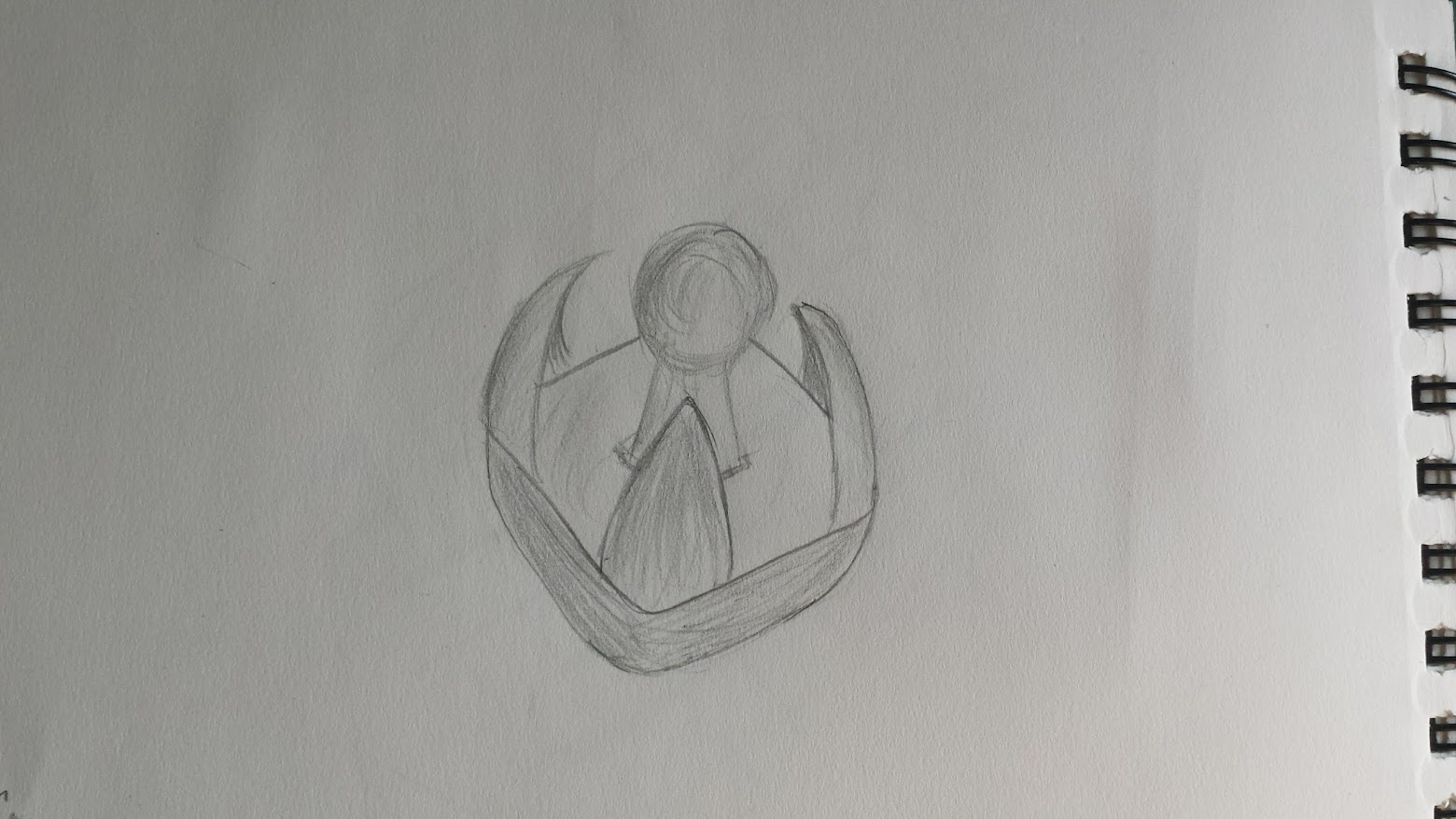
Ansible drawing
This is the really the wrong note for this, since I made this drawing in 2017 and didn't read LHOD in 2020. So this drawing is actually my mind's representation of an ansible from the Ender's Game series, not LHOD. But this drawing was inspired by an ansible (or what my mind thought it would look like) I saw in a dream (7/24/2017).
I stubbornly do not mark this audiobook re-read on Goodreads as a book read. I just don't track audiobooks for Goodreads. Mainly for the purpose of the yearly Reading Challenge. It doesn't "count" to me. I acknowledge there is inherent and equal value in the audiobook. But I more value the more conscious effort of direct reading, in the context of the reading challenge. ↩︎
had to look up spelling since I've only heard WoT as audiobook. ↩︎