All nearness pauses while a star can grow (E.E. Cummings)
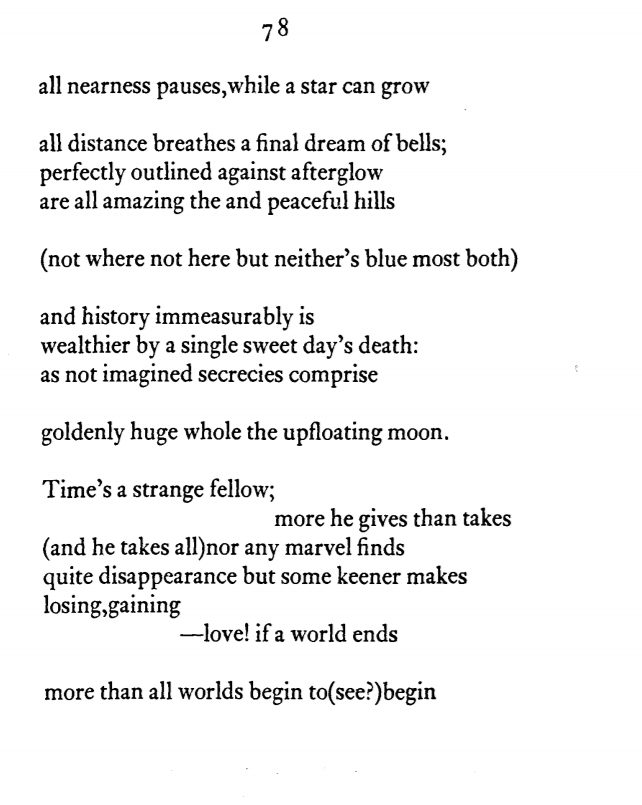
I selected and analyzed this poem for my high school English class. It's probably one of my favorite poems ever, if only because I spent some time puzzling over it, but also I love the imagery and the mysteries that it still contains for me (seriously, still don't understand "not where not here but neither's blue most both). Also because I memorized it (just for fun - I wasn't required to memorize it).
I try to test myself sometimes to see if I still have it memorized -- usually I don't, except for snippets. It's kind of fun to piece it back together after all these years.
Kind of arbitrary, but thinking about the poem evokes my childhood bedroom in my mind, probably because I had written out the poem on the whiteboard in my room while I was memorizing and analyzing it.
Some of the lines have really stuck with me. "more he gives than takes" gives me chills -- thinking about what we gain with time rather than what we lose. Also get chills from the last few lines. Something plays in my mind when I read those last lines (well really throughout the whole poem), an image of a sunset, an image of many doors or worlds floating in midair (this must be a remnant of "if a world ends... worlds begin to begin" being the equivalent of "one door closes, another one opens"), and when I read the "(see?)" I literally gasp, a small, sharp intake of breath, or I visualize someone gasping as they see the evidence of what is being told to them, knowing it's true, seeing something new coming over the horizon.[1]
I'm literally going to paste my analysis from that English class below. I do not claim to be 100% on the same page with what my past self wrote here. (some of it honestly seems like a bit of a stretch... But I can't blame my past self. It's a complicated and confusing poem!)
(I feel weird adding this caveat, but my high school era was before AI-generated content, so yes this is analysis is 100% written by me (though, I think I remember getting help for a few things from the web, in particular the word swap thing ("the and peaceful hills"). I think everything else was just from my own contemplation.))
My English class analysis
- “all nearness pauses,while a star can grow”
- “A star can grow” represents sunset, when the sun (a “star”) appears to “grow” as it approaches the horizon
- “All nearness pauses” — the beauty and importance of the setting sun makes anyone watching it “pause” for a moment, staying still and remaining silent.
- The comma in “pauses,while” emphasizes this pause, even though the comma is grammatically unnecessary. E. E. Cummings frequently uses punctuation to convey deeper meaning in this way.
- “all distance breathes a final dream of bells;”
- As the sun sets, the sounds and events of the day are beginning to die down.
- The start of the night begins with an exhale of breath, and the events of the day fade from immediate memory like a “dream”.
- “perfectly outlined against afterglow”
- “Afterglow”: light remaining in the sky after the sun has set
- Also “afterglow”: good feelings remaining after a pleasurable or successful experience
- The setting of the sun could signify the ending of a pleasurable event, or even one’s life. The “outline against afterglow” is the pleasant but fading memory of what is lost to the past.
- “are all amazing the and peaceful hills”
- Cummings purposely rearranges the standard order of the words in the phrase “are all the amazing and peaceful hills”.
- He does so to momentarily disorient the audience, emulating the loss of coherent words one experiences when observing a setting sun.
- This feature is seen in several other of Cummings’ poems.
- “(not where not here but neither’s blue most both)”
- This perhaps is in response to the question of “Where is the sun setting?”. In response, the narrator responds that where is not an appropriate question to ask, and that the sunset also did not occur here. This emphasizes that the sunrise occurs everywhere at once (for one hemisphere), not in just one particular place. Anywhere the sunset has just occurred, the sky will no longer be blue, because it is now night. However, the sky is only mostly devoid of blueness, because of the “afterglow” leaving behind some color.
- Figuratively, this could be answering the question, “Where did the events of my life occur?”. The answer is that they did not occur in any one place, but rather the impact of the events is so broad in history that their impact can be seen everywhere. Just as the sky is no longer blue after a sunset, the world is not the same as it was after these life events occurred, and the feeling or memory of those events is almost completely gone from one’s mind. However, some residual feelings of the events remain, so they are not yet completely lost.
- “and history immeasurably is / wealthier by a single sweet day’s death”
- The sunset represents another day passing
- Every day that passes, the events and experiences of that day are added permanently to history
- “as not imagined secrecies comprise / goldenly huge whole the uploating moon”
- When day ends, the moon remains in the sky to shine over the night.
- The moon is a symbol of the day’s end and the transition of the next day, made up (“comprised”) of all the things that have not yet come to pass (“not imagined”). These future “secrecies” lie in wait for the coming day to see them to fruition, and meanwhile the moon holds on to them.
- “Time’s a strange fellow;/more he gives than takes/(and he takes all)”
- Personifies the concept of time — the narrator reflects on Time as a peculiar creature who acts in an usually generous way.
- What does time give and take?
- Time takes youth, vitality, and life, and gives in return experience and wisdom
- Time takes days of the past, and gives to the future the histories that they contained
- “More he gives than takes” —
- The experience and wisdom gained over time are more valuable than the lost youth — losing youth is worth it for what is gained
- “More he gives than takes/(and he takes all)” — paradox: implies that Time gives more than “all”. Stresses the great extent to which Time gives.
- “Nor any marvel finds/quite disappearance but some keener makes/losing,gaining”
- “Marvel”: a wonderful or astonishing person or thing
- To this type of person, the days/time/youth that are lost do not “quite” feel like they have disappeared. Instead, they are able to turn losses into gains.
- Looking back at the lost days of one’s life should be fulfilling, even if those things can never again be experienced.
- The narrator implies that the audience should also view their losses in this way
- “—love! if a world ends/more than all worlds begin to(see?)begin
- [if a world ends, more than all, worlds begin to begin]
- A closing door means that more doors begin to open, and new opportunities may arise
- The day ending means that more days with new opportunities/experiences will follow
- Could also signify the end of one’s life, and the entrance to the afterlife. “See?” may be the narrator gesturing to the audience as they die and enter the afterlife.
- The object in question is a “world” — this magnifies the sensation of loss and gain, on the planetary level
- [if a world ends, more than all, worlds begin to begin]
- Overall meaning of the poem
- Presents an optimistic view of loss, whether it be the loss of a good experience, or the loss of one’s life.
- What is lost is also a gain whether in memory or experience, and the fact of loss means that new things (such as the afterlife) can be experienced
also kind of evokes Eliza's gasp at the end of Hamilton. (I wonder if that Hamilton association is remnant of my interest in it during high school and so it became imbued with this poem, or if it's just because of the connection to the gasp that I'm thinking about now.) ↩︎